

There’s a sentence I hear surprisingly often whenever the subject of artificial intelligence comes up:
“I’m too old for that.”
And every time I hear it, I want to say, “Are you kidding me? Look at everything you’ve already learned. If you’re a grandparent today, think about the amount of technology that has appeared during your lifetime.
You probably remember when televisions had antennas and only a handful of channels. You watched microwave ovens appear in kitchens. You learned how to use ATMs, answering machines, VCRs, personal computers, cell phones, email, text messaging, GPS, smartphones, FaceTime, online banking and streaming television.
Somewhere along the way, you may also have spent twenty minutes searching for your glasses while they were sitting on top of your head, but that’s beside the point. You adapted. Again and again.
Now artificial intelligence has arrived, and suddenly a lot of perfectly capable people are standing at the edge saying, “Nope. This one is too complicated.”
It really isn’t.
AI Is Much Simpler Than It Sounds
The words “artificial intelligence” sound enormously technical. Using it often isn’t. With an AI assistant such as ChatGPT, you can simply type a question in ordinary language.
“Help me plan dinner using chicken, potatoes and carrots.”
“Explain this letter from my insurance company in plain English.”
“What are some rainy-day activities I can do with my grandchildren?”
“Help me write a nice thank-you note.”
And the AI responds. That’s basically how it begins.
You don’t have to understand programming. You don’t need special computer skills. You don’t have to learn a complicated set of commands. You talk to it. It talks back.
But What If I Do Something Wrong?
 One of the biggest fears beginners have is that they’re going to press the wrong button or ask the wrong question. The good news is that there really isn’t much damage you can do. You are not going to break ChatGPT. You are not going to crash the internet. You are certainly not going to accidentally launch a satellite.
If the AI misunderstands what you’re asking, you simply try again.
Imagine asking a librarian for a book and having her bring you the wrong one. You wouldn’t assume you had somehow failed at libraries. You’d say, “That’s not quite what I meant.” You can do exactly the same thing with AI.
“Explain that more simply.”
“Give me another example.”
“That wasn’t what I meant. Let me try asking differently.”
Those are perfectly good instructions.
Curiosity Matters More Than Computer Skills
Here’s something I wish more people understood: The people who benefit most from AI are not necessarily the people who understand technology best. They’re often simply the people willing to ask questions.
Curiosity is far more valuable than technical vocabulary. In fact, one of the nicest things about learning with AI is that there’s nobody standing over your shoulder judging you.
You can ask the same question five times, misspell things, change your mind halfway through. You can say, “I have no idea what you just said. Explain that like I’m twelve.” And it will. Try that with your cable company.
What AI Can’t Replace
There’s another concern worth addressing. People frequently hear that artificial intelligence is going to replace human beings. AI will absolutely change the way many people work. Technology always does. But there are things artificial intelligence cannot replace.
It cannot love your grandchildren, sit beside someone during a difficult season of life, replace your memories, your family stories, your judgment or the wisdom you gained from decades of living.
AI can help you organize information, write something, learn something, research something or think through a problem.
But you are still the human being holding the tool. A power drill doesn’t build a house. The carpenter does.
Start With One Question
If AI still feels intimidating, don’t try to become an expert. Try one question. That’s it. Open ChatGPT and type:
“Hi. I’m new to AI. Please explain things in plain English and be patient with me while I learn.”
Then ask something you actually care about.
Gardening.
Travel.
Family history.
Recipes.
Bible study.
A hobby.
Your grandchildren.
The best way to become comfortable with AI isn’t reading twenty articles about it. It’s having your first conversation. And after everything your generation has already learned to use, I have a feeling this will be much easier than you think.
___________________________________________
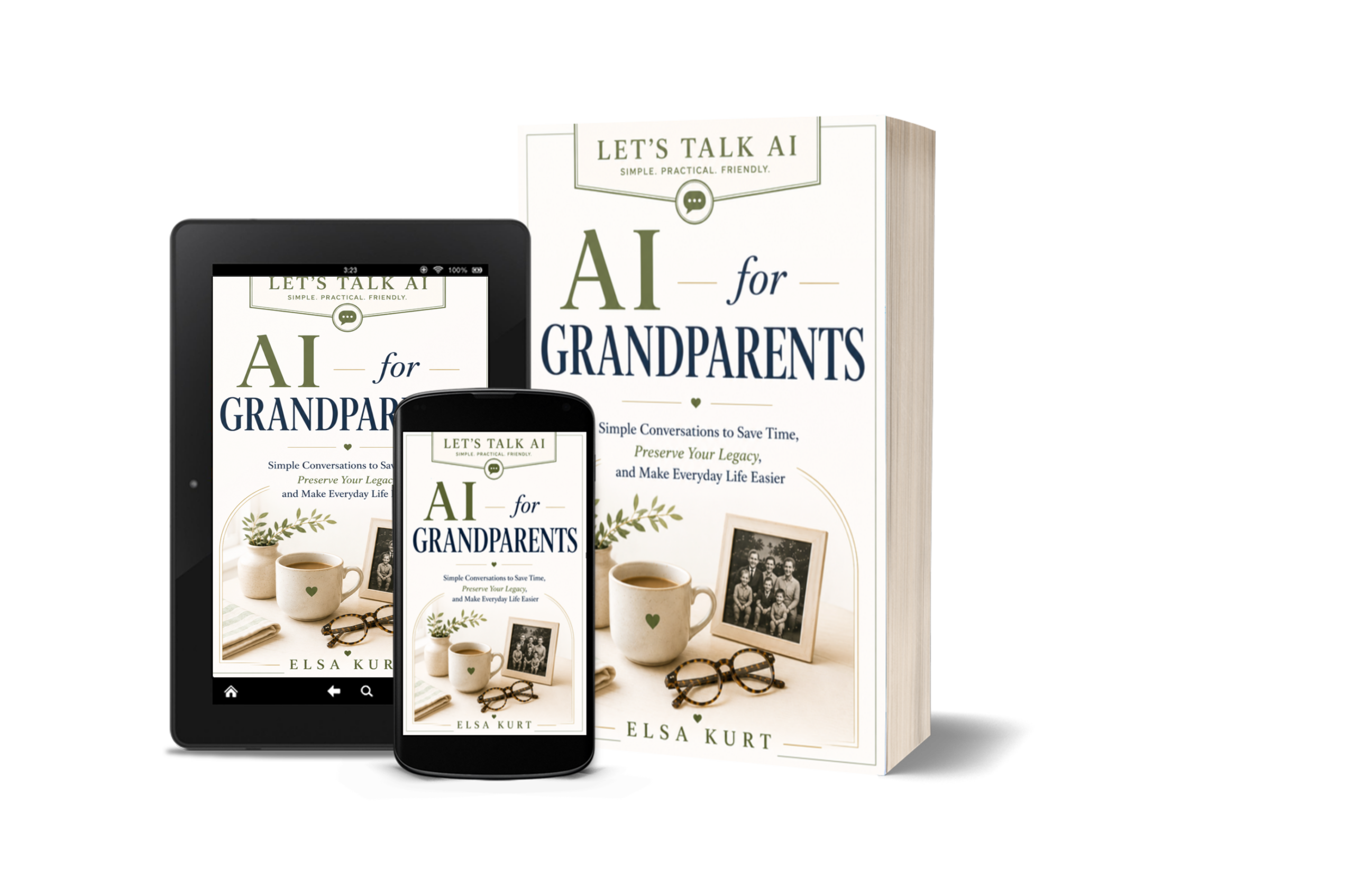
Let’s Talk AI| AI For Grandparents by Elsa Kurt Available Now on Amazon
AI doesn’t have to be complicated.
If you’ve ever thought…
• “I’m too old to learn this.”
• “I’m afraid I’ll break something.”
• “I don’t even know where to begin.”
…this book was written for you.
Whether you want to preserve family memories, write letters to your grandchildren, organize recipes, simplify everyday tasks, plan vacations, understand technology, or simply keep up with a rapidly changing world, AI can become one of the most helpful tools you’ve ever used.
You don’t need to be “good with computers.”
You just need to know how to have a conversation.
AI Made Easy: For Grandparents walks with you step by step using plain English, practical examples, and hundreds of ready-to-use prompts that help you save time, preserve your legacy, and enjoy life a little more.